Mohs Surgery
Fellowship-Trained Mohs Surgery in Chevy Chase
Mohs surgery is a highly specialized technique used to treat skin cancer with precision and accuracy. For patients facing a skin cancer diagnosis, the primary goals are simple: remove all of the cancer while preserving as much healthy skin as possible. Mohs surgery is designed to do exactly that. Dr. Patricia Richey is a board-certified dermatologist and fellowship-trained Mohs surgeon, who is also fellowship-trained in laser and cosmetic dermatology.
Mohs surgery is most commonly used for skin cancers that develop on areas where preserving healthy tissue is especially important, such as the face, ears, nose, lips, eyelids, scalp, neck, hands, and lower legs. It is also recommended for cancers that are large, have irregular borders, have come back after previous treatment, or show aggressive growth patterns under the microscope.
Unlike standard surgical removal, where a visible tumor is removed along with a margin of surrounding tissue and then sent to a laboratory for evaluation days later, Mohs surgery is performed in stages during a single visit. The tissue is examined immediately under a microscope while the patient waits comfortably in the office. This real-time analysis allows the surgeon to confirm whether any cancer cells remain before proceeding. Your surgeon is also a pathologist which means all of the tumor cells are removed the same day. No waiting anxiously for the pathologist’s report.
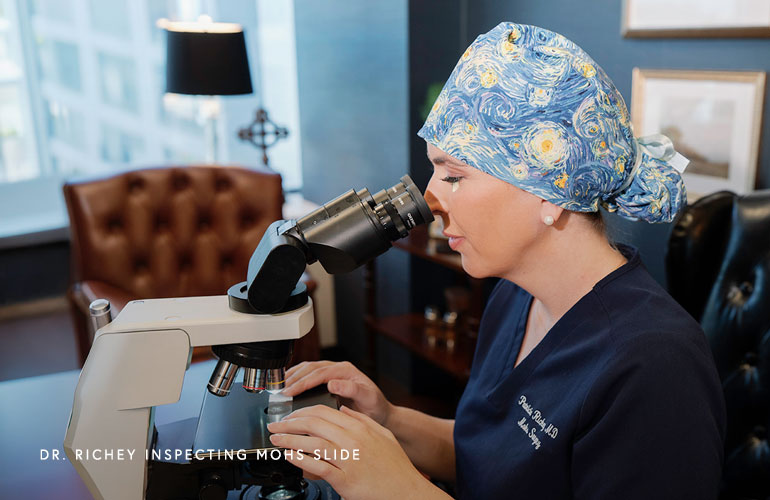
The procedure begins with local anesthesia to numb the area. Patients remain awake throughout, but the treatment site is fully numb. Dr. Richey removes the visible tumor along with a very thin layer of surrounding tissue. That tissue is carefully mapped, color-coded, and processed in an on-site lab. Dr. Richey then examines the entire margin of the specimen under the microscope. This step is what makes Mohs surgery unique. Instead of sampling small portions of the margin, the entire edge is reviewed.
If cancer cells are seen at any edge, Dr. Richey returns to the precise location on the skin where those cells remain and removes another thin layer. Only the area with remaining cancer is addressed, leaving healthy tissue untouched. The process repeats until no cancer cells are detected. This staged approach ensures complete removal while sparing as much normal skin as possible.
Because every layer is evaluated immediately, Mohs surgery offers cure rates of up to 99 percent for many common skin cancers that have not been treated before. Even for recurrent cancers, cure rates remain very high. This level of accuracy is especially important in cosmetically sensitive areas where taking too much tissue can affect appearance and function.
Once the cancer has been completely removed, attention turns to reconstruction. The wound may be allowed to heal naturally, closed with stitches, or repaired using advanced reconstructive techniques such as skin flaps or grafts. Dr. Richey carefully considers both cosmetic and functional outcomes when planning reconstruction. The goal is not only to remove the cancer but also to restore the area in a way that blends as naturally as possible with surrounding skin.
Recovery after Mohs surgery is generally straightforward. Most procedures are performed on an outpatient basis, and patients go home the same day. Mild swelling, bruising, or discomfort can occur, particularly when surgery is performed around the eyes, lips, or nose. Pain is typically manageable with over-the-counter medication. Detailed wound care instructions are provided to support proper healing and reduce the risk of infection.
Patients are often surprised by how methodical and controlled the process feels. Although the procedure can take several hours due to the staged tissue analysis, much of that time is spent waiting comfortably between stages. The careful pace is intentional. The objective is complete removal, not speed.
Mohs surgery is not necessary for every type of skin cancer. Many small, low-risk tumors can be treated effectively with other methods. However, when cancer occurs in high-risk locations, has unclear borders, or shows aggressive features, Mohs surgery offers clear advantages. Its precision reduces the likelihood of recurrence and limits the removal of healthy tissue.
Choosing a fellowship-trained Mohs surgeon matters. The technique requires specialized training in both surgical removal and microscopic interpretation of tissue. Dr. Patricia Richey combines these skills in a single visit, serving as both surgeon and pathologist during the procedure. This dual expertise is what allows Mohs surgery to achieve such high success rates.
Patients often feel anxious before skin cancer treatment, especially when the face is involved. Understanding the process can ease those concerns. Mohs surgery is deliberate, thorough, and designed to prioritize both health and appearance. By removing cancer layer by layer and confirming clear margins in real time, it offers confidence that the cancer has been fully addressed.
For individuals diagnosed with certain types of skin cancer, Mohs surgery represents the most precise treatment available. It is a focused, evidence-based approach that balances complete cancer removal with careful tissue preservation. Under the care of an experienced Mohs surgeon like Dr. Patricia Richey, patients receive treatment centered on accuracy, safety, and long-term skin health.
Board-certified dermatologist and double board-certified Mohs surgeon Dr. Patricia Richey specializes in Mohs surgery for skin cancer. She is widely regarded as one of the leading Mohs surgeons in Chevy Chase, Bethesda, and the surrounding communities. She sees patients at her Chevy Chase office and proudly treats patients from Chevy Chase, Bethesda, Potomac, and Washington, DC.
At a Glance
Dr. Patricia Richey
- Board-certified dermatologist
- Fellowship-trained and board-certified Mohs surgeon
- Harvard fellowship-trained in lasers and cosmetics
- Author of innovative dermatology research and publications
- Learn more
